


- Details
- Written by Tong
- Hits: 8181

Hao Weizhen (Hao He)
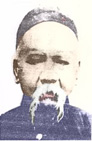
Hao Weizhen (郝为真, Pinyin: Hǎo Wéizhēn), personal name Hao He (郝和, Pinyin: Hǎo Hé), style name Weizhen, was born in 1849 and died in 1920. He was a native of West Street (西街, Pinyin: Xījiē) inside Guangfu (广府, Pinyin: Guǎngfǔ), Yongnian (永年, Pinyin: Yǒngnián), Hebei (河北, Pinyin: Héběi). He was tall and powerfully built, yet steady and sincere in temperament—resolute, quick-witted from youth, fond of letters and devoted to martial practice, combining scholarly refinement with practical martial substance.
The Wu (武) and Li (李) families of Yongnian were local gentry lineages who prided themselves on classical learning and did not readily display boxing skills. Raised in this environment, Hao first trained in external styles, but later felt that they leaned toward hard force and could not fully express the highest principles of combat skill and self-cultivation. He therefore turned to Taijiquan.
In his early years, Hao studied Taijiquan under Grandmaster Li Yiyu (李亦畬, Pinyin: Lǐ Yìyú). Diligent and relentless, he was taught the art’s “true essentials” within six years. These “six years” mark the stage of grasping the key meanings and entering the method; thereafter he continued to practice for more than twenty years, refining through experience, verification, and integration until his attainment became thoroughly mature.
Li Yiyu was not one to grant approval lightly. Seeing Hao’s respect for teachers and for the Way, his upright character, and his deep comprehension, Li regarded him as the bearer of the lineage and personally transmitted to him the recorded Taijiquan Manual 《太极拳谱, Pinyin: Tàijí Quánpǔ》, together with the classic treatises authored within the Wu Yuxiang (武禹襄, Pinyin: Wǔ Yǔxiāng) and Li Yiyu tradition.
The treatises of the Wu and Li families are concise in wording yet profound in principle; their postures appear simple outwardly but contain rich inner substance. Their crucial points cannot be exhausted without oral instruction and embodied demonstration. Many learners could not penetrate their depth; Hao alone was able to transmit the essential methods and keys.
Hao’s Taijiquan centers on the principle of “emptiness and vitality as the body; following and adapting as the function” (虚灵为体,以因循为用, Pinyin: Xūlíng wéi tǐ, yǐ yínxún wéi yòng). He did not pursue dangerous tricks, but emphasized structure, listening skill (听劲, Pinyin: tīngjìn), and whole-body coordination.
Tradition holds that his push-hands (推手, Pinyin: tuīshǒu) skill could keep a person seated steadily even when a chair was pushed from more than a zhang away; when protecting a child, he could extend both arms like wings and remain unmoved despite the crowd’s pushing. His qinna (擒拿, Pinyin: qínná) within push-hands was especially subtle: he subdued skilled external-style fighters such as Luo Jianxun (罗建勋, Pinyin: Luó Jiànxūn) and Ge Laotai (葛老泰, Pinyin: Gě Lǎotài) without injuring them—winning while still winning the opponent’s heart.
Hao often used “moving through the form” (走架, Pinyin: zǒujià) to describe stages of realization: first, like standing in water and being moved by waves; next, like a skilled swimmer who forgets the water—steps seeming not to touch the ground, rising and sinking at will; and finally, with steps ever lighter and the body forgotten, as if walking upon the surface of water, drifting as though roaming among clouds.
In his early years, Hao worked in his maternal uncle’s rice business and regularly delivered rice to Li Yiyu’s household; through this connection he was able to study the art. With Li’s assistance he later established his own rice shop and his family’s means improved, but when his children could not help manage the business, he closed it in frustration and turned to selling malt sugar—still insufficient to support a large household.
He ultimately divided the property and let the children establish their own households, while he himself became a boxing instructor at Yongnian Middle School. From this point, Taijiquan no longer remained only an inner-family transmission but entered a stage of public teaching.
After Li Yiyu passed away, Hao began teaching openly at the request of many. His skill was said to have reached a wondrous level—every movement effective, his reputation spreading far and wide. Students came from every social stratum and from all directions.
The broad dissemination of Wu-style Taijiquan began in this period. The school founded by Wu Yuxiang was truly carried forward through Hao, laying a firm foundation for the rapid expansion and branching of Taijiquan styles in the 1930s.
Hao also authored On Taijiquan Training Methods 《论太极拳练法, Pinyin: Lùn Tàijí Quán Liànfǎ》 to clarify principles and pathways of practice.
Hao taught many students in his lifetime. Among the principal transmitters, besides his second son Hao Wengui (郝文桂, Pinyin: Hǎo Wénguì), were Sun Lutang (孙禄堂, Pinyin: Sūn Lùtáng; 1861–1932) and Li Xiangyuan (李香远, Pinyin: Lǐ Xiāngyuǎn; 1889–1961), among others.
Li Xunzhi (李逊之, Pinyin: Lǐ Xùnzhī; 1882–1944), the second son of Li Yiyu, was born into a family of boxing scholarship; nevertheless, much of his Taijiquan skill was transmitted by his senior brother in the art, Hao Weizhen.
Hao had four sons: Wenqin (文勤, style name Jingyuan 敬远), Wengui (文桂, style name Yueru 月如), Wentian (文田, style name Yangeng 砚耕), and Wenlin (文林, style name Zhuxian 竹贤). Of these, Wengui and Wentian were able to inherit the family learning, with Wengui’s art regarded as the most refined. As the Hao family declined, Wengui took up teaching as a profession, and Wu-style Taijiquan began to spread from Yongnian to other regions.
For Wu-style Taijiquan, Hao Weizhen was not merely a renowned teacher of one generation but a crucial pivot connecting inheritance and dissemination. He both fully inherited Li Yiyu’s system and, through personal verification and teaching practice, brought a previously reserved and inward tradition into wider society.
What he realized through a lifetime of practice echoes his own saying: “The subtlety of this art does not depend on one’s natural strength or weakness; while one lives, there is progress without end.”
Historical Context Note
Some details of Hao Weizhen’s life differ slightly across sources—for example, the length of training and certain family-name listings. This article follows the official Wu-style Taijiquan lineage narrative as its backbone, supplemented by local materials and modern research, aiming to present a historical thread that remains consistent with transmission logic and can be cross-validated.
Within traditional Chinese martial culture, terms such as “receiving the essentials (得诀, Pinyin: Dé jué),” “lineage mantle (衣钵, Pinyin: Yī bō),” and “transmitting key methods (传其窍要, Pinyin: Chuán qí qiào yào) ” carry specific hierarchical meanings and cannot be reduced to modern notions such as “years of study” or “number of students.” Hao Weizhen’s historical position should be understood within this cultural and institutional context.