


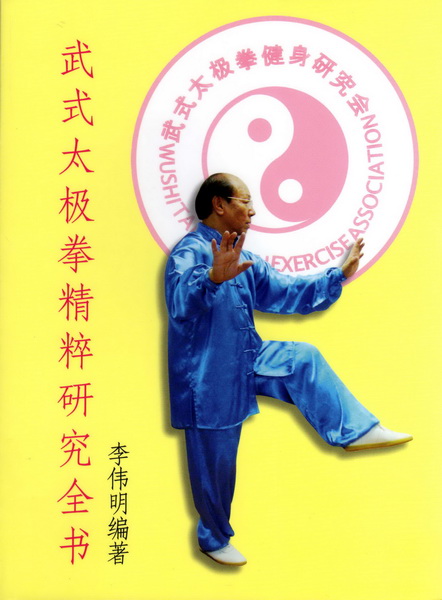
Comprehensive Study of the Essence of Wu Style Taijiquan
Preface
Chinese martial arts possess a long history, rich content, and numerous lineages. Among them, Taijiquan, as one of the most important martial arts systems, has long been cherished by practitioners both in China and around the world.
Taijiquan is an indigenous Chinese discipline devoted to strengthening the body, defending against aggression, calming the mind, and extending longevity. It is characterized by looseness, stillness, naturalness, softness, sinking, stability, continuity, roundness, and liveliness. In practice, every movement of Taijiquan contains martial meaning. Only through a deep understanding of body structure, internal power, and the transformation between emptiness and fullness can one use the “subtle circulation of internal qi” to govern external form, guide qi with intent, and move power through qi throughout the entire body—thereby cultivating jing, qi, and shen. This method, which emphasizes internal accumulation beyond mere external appearance, is essential for advancing proficiency in Wu Style Taijiquan.
Taijiquan is a traditional Chinese martial art with profound depth and an enduring lineage. Over centuries of development, five major styles emerged, among which Wu Style Taijiquan stands as one of the principal lineages.
Wu Style Taijiquan was transmitted and refined across five successive generations: Wu Yuxiang (武禹襄, Pinyin: Wǔ Yǔxiāng), Li Yiyu (李亦畬, Pinyin: Lǐ Yìyú), Hao Weizhen (郝为真, Pinyin: Hǎo Wéizhēn), Hao Yueru (郝月如, Pinyin: Hǎo Yuèrú), and Hao Shaoru (郝少如, Pinyin: Hǎo Shàorú). Through continuous refinement and preservation, this lineage developed into a complete and coherent Taijiquan system.
The high esteem accorded to Wu Style Taijiquan arises largely from the contributions of Wu Yuxiang and Li Yiyu, who integrated hands-on practice with deep theoretical inquiry, elevating Taijiquan theory to an unparalleled level. Their writings, together with the Taijiquan Treatise《太极拳论》 (Pinyin: Tài Jí Quán Lùn, a classical work expounding the principles and structural foundations of Taijiquan), are revered as canonical texts across modern Taijiquan schools.
Wu Style Taijiquan is distinguished by clarity of principle, depth of theory, and a unique technical character. To promote its understanding and meet the needs of beginners, a clear and accessible instructional text is essential—this is the motivation behind the present book.
The author began formal training at an early age under Hao Shaoru, the fifth-generation inheritor of Wu Style Taijiquan. Over decades of persistent practice, research into body structure and internal power, and systematic reflection, the author accumulated extensive experience and insight, culminating in the careful completion of this work.
The structure of this book emphasizes martial virtue, cultural depth, foundational training, and the study of principles. Guided by a pedagogy in which theory leads form, it focuses on traditional Wu Style Taijiquan routines, technical characteristics, and essential methods. It explains how intent guides internal power and governs external movement, and it summarizes decades of instructional experience. This book aims to contribute meaningfully to both the dissemination and advancement of Wu Style Taijiquan, serving practitioners of varying backgrounds.
Main Contents
Part I: The origins of Wu Style Taijiquan.
Part II: Medical and health benefits of Wu Style Taijiquan (nervous, cardiovascular, respiratory, digestive systems, etc.).
Part III: Taijiquan principles and methodology—how to study Wu Style Taijiquan effectively.
Part IV: Fundamental training and overview of body structure methods.
Part V: Forms practice, including illustrated explanations of postures and sequences.
Part VI: Pushing hands—fixed-step and moving-step training methods.
Part VII: Weapons training—Wu Style Taiji Sword, Thirteen Saber, Thirteen Spear, paired spear, and adhesive spear drills.
Part VIII: Technical explanations and theoretical discussion (emptiness, looseness, roundness, liveliness; storing and releasing power).
Part IX: Classical Taijiquan treatises.
Appendix: Historical figures and lineage charts of Wu Style Taijiquan.
Overview of Wu Style Taijiquan
Wu Style Taijiquan is one of the five major traditional Taijiquan lineages. It was founded during the Qing dynasty in Guangfu, Yongnian, Hebei, by Wu Yuxiang. Through five generations of careful transmission, it developed into a complete theoretical and practical system.
Its characteristics include concise external form, compact postures, slow and controlled movement, agile footwork, upright tailbone alignment, clear differentiation between empty and full, and balanced division of the body between left and right without overextension. Internal cultivation is emphasized, using internal transformation to guide external movement. Every posture embodies the cycle of “qi (起, Pinyin: qǐ), cheng (承, Pinyin: chéng), kai (开, Pinyin: kāi), and he (合, Pinyin: hé).” Kai corresponds to expansion—breathing out, releasing, and projecting power—while he signifies contraction—breathing in, storing, and gathering power. The continuous transformation between these states forms the living dynamic of Wu Style Taijiquan.
How to Study Wu Style Taijiquan
Effective practice requires a clear understanding of the nature and philosophy of Wu Style Taijiquan. Foundational training, known as preparatory training (预备功, Pinyin: yù bèi gōng), is essential. This training serves three purposes: preparing body structure, building physical capacity, and calming the mind to stabilize internal energy.
Preparatory training is a method of internal cultivation marked by external stillness and internal movement. Through sustained practice, it strengthens musculature, enhances lower-body stability, promotes qi sinking to the dantian, and gradually builds internal power—laying a firm foundation for advanced practice.
The Three Stages of Practice
Stage One: Learning the Form
This stage focuses on external structure and accuracy. Like constructing a building, the foundation must be sound before refinement can occur. Correct posture ensures the proper development of internal power.
Stage Two: Learning Body Structure Methods
Wu Style Taijiquan employs The Thirteen Body Structure Methods (十三条身法, Pinyin: shí sān tiáo shēn fǎ), which form the structural foundation of internal practice. These principles guide the coordination of body, hands, and steps into a unified whole.
Stage Three: Learning Internal Power
Taijiquan is a highly integrated discipline encompassing philosophy, mechanics, physics, medicine, anatomy, meridian theory, kinesiology, and qigong. Understanding these fields enables practitioners to grasp the essence of Taijiquan and the true nature of martial application.
This book provides illustrative examples to clarify the relationship between intent and qi, as well as action and reaction forces. Such understanding supports deeper study of power release and the interaction between intent and qi. The author’s decades of disciplined practice and research inform the systematic presentation found herein.
This book was published in Bangkok, Thailand, in November 2009. Those interested in purchasing the book or studying Wu Style Taijiquan may contact the numbers listed below.
Shanghai: +86-21-52281896, +86-13651715119
Bangkok: +66-81-9119424, +66-86-5598753, +66-81-9910339
The author, Li Weiming (李伟明), has also published a full-color book titled Li Family Taiji Qigong Therapy for Disease Prevention《李氏太极气功祛病疗法》 (Pinyin: Lǐ shì Tàijí Qìgōng Qūbìng Liáofǎ). He currently teaches Wu Style Taijiquan in Shanghai through individual instruction.